Posts

Intro to PET

Image
by Neil Harris It was March of 1978 and I was in love. We had been dating for a year, and it was time to get serious. I knew that because she told me so. “I won’t marry you until you get yourself on a career path.” I was young and directionless until that point. I had learned to program computers in high school and had spent every free moment there writing games and other programs. But programming for a living seemed boring, so when I went on to college I did not study computer science and, before long, had dropped out. I worked odd jobs – driving a taxi, working in a drugstore, even as an ice cream man one summer. I did work as a programmer for a while, for a small company that wrote accounting software for local businesses – and it was as boring as I expected. But I was in love. So, I got a proper haircut and a new suit and checked the want ads in the newspaper.  One ad caught my eye right away: “Sales help wanted for calculator and home computer store. Mr. Calculator, 1700 Sanso...
Creating PETSCII

Image
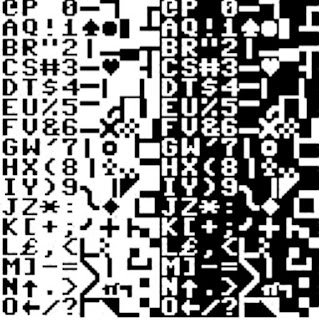
by Leonard Tramiel When Chuck Peddle was given the go ahead to bring his ideas of what would become the PET computer into reality many of the ingredients were only loosely constrained. One example is the character set. It would clearly need to have alpha-numeric characters and the basic punctuation. But that was far  too limiting for many recreational uses of the machine. It should be possible to create a set of graphics characters that would allow a wide range of images to be created yet still have the hardware simplicity of a character based system. He knew that one of the likely uses of the computer was going to be card games. The game of Blackjack was a favorite of both Chuck and my dad. That meant the only thing that was well defined about the set was that it needed to have the four suits; hearts, clubs, spades and diamonds. He gave me the task of designing that character set. Each screen location would store an 8 bit number, 256 possibilities. The top bit would swap on and of...

Why a moth?

Image
by John Feagans The moth sculpture outside Coover Hall on the Iowa State Ames campus. Why a moth? It represents the first computer bug found when Admiral Grace Hopper removed a moth stuck between relay contacts. There are pure bugs and then there are design flaws that are also bugs. In the 8k PET we started noticing a period of time where the PET would seem to hang then wakeup again.  I traced it down to using all of string space and the garbage collect would kick in. When we had prototypes of the dynamic RAM 32k PET in early 1979  this seeming hang became more pronounced. 10 A$=TI$ 20 ? A$ 30 GOTO 10 Each time a string variable instanced, the previous data became garbage unusable memory. To free and reuse this memory, garbage collection was necessary.  Unfortunately, Microsoft programmed the descriptors and data as a singularly linked list meaning that moving through string space, every location required a linear search of the descriptors to see if anyone was pointing at...

Interrupts are ... tricky

by Leonard Tramiel Some early PET users reported that their machines would "hang". After doing ... something the machine would become unresponsive. Nothing short of a power cycle would get the machine back into operation. The hardware folk on the project said it was obviously a software problem and, not surprisingly, the software folk said it was a hardware problem. As mentioned in another entry here, there were some ... idiosyncrasies in the MOS memory being used. In particular the 6550 pseudo static RAM. This was an interesting(?) device, it had a combination of the characteristics of a static and a dynamic RAM but none of the advantages of either. Dynamic, as opposed to static, RAM has fewer pins so it greatly reduced the number of traces on the board but it needs external logic to generate the address signal and it needs a regular pattern of signals to produce a refresh signal. Static RAM uses simpler addressing so more pins but doesn't need to be refreshed. The 6550 ...

My introduction to VIC

Image
by Leonard Tramiel VIC concept computer at Chicago summer CES 1980. Photo by John Feagans. As mentioned in another  one of these posts, I was asked by my dad to give him my opinion of going along with Chuck Peddle’s idea for a computer. Shortly after working in the team that developed that machine from idea to fully working prototype I left Commodore to further my education. While in my apartment in New York City I got a call from Dad asking me to do the same thing again. One of the engineers at MOS Technologies had made a demo to show what could be done with one of their chips. It was going to be displayed at CES in Chicago and dad wanted me there to see it and tell him what I thought. I went to Chicago, to the all too familiar environment of a trade show. I had been regularly going to these shows since I was about 12. Often giving demos of Commodore’s calculators to the throngs of people in attendance. The show was like all the others, but instead of spending my time in the publi...

Self testing PETs

by Leonard Tramiel One of the events in the year or so I spent working on the PET that sticks out in my mind was testing the first batch of boards. It felt surreal, even at the time, to take a board out of a box, plug in a power supply, monitor, and keyboard and have a computer that was unavailable only a short time before. The first batch of PET boards used an ... unusual RAM chip made by MOS Technology. Besides being an design that was a hybrid of static and dynamic RAMs, with none of the advantages of either. the chips had a high percentage of bad devices. The factory testing didn't find bad chips but ones that did work were pretty reliable. When the first batch of boards came in from the manufacturer, most of the machines didn't work correctly. One of the features of Microsoft BASIC is a memory test that does a simple check of memory and reports the number of bytes that were found to be available. In these 8K PETS that number should have been 7167. Most of the machines woul...

How we developed our firmware

Image
 By John Feagans MDT 650 connected ICE to 2020 printer board in development The first 6502 cross assembler was written in Fortran by Michael Corder--aka the Cordless Electric Programmer. Before it was installed on the 360 I had to preface my 6502 assembler punched cards by this huge deck of the assembler program itself written in Fortran, then wait for the batch processing. Later MOS Technology offered the assembler on Tymshare for remote connections. On the side as a grad student at Iowa State, Ames,  in computer science I was enlisted by Compas for several projects they had contracted with MOS Technology. The facilitator in this was again Dr. Roger Camp of the Electrical Engineering department as I mentioned in my blog post "Door Into Summer". Dr. Camp is retired now and we keep in touch. He told me how he met Chuck Peddle. "I took a years sabbatical from ISU and worked for Motorola in Tempe AZ and sniffed out a small group in a small office down the hall on a super se...